Reducing Workflow Ambiguity to
'Improve Delivery Accuracy and Efficiency'
in Vessel Operations.

Quick Summary with Final Prototype Video
———
Quick Summary with Final Prototype Video
———
Quick Summary with Final Prototype Video
———
Problem: Engineers skipping real-time logging from application while taking goods delivery
Action: Redesigned taking delivery workflow aligned with engineer mental models
Outcome: Improved adoption among engineers by 93% and reduced operational errors by 40%
Impact: Better data accuracy and reduced revenue leakage
Problem: Engineers skipping real-time logging from application while taking goods delivery
Action: Redesigned taking delivery workflow aligned with engineer mental models
Outcome: Improved adoption among engineers by 93% and reduced operational errors by 40%
Impact: Better data accuracy and reduced revenue leakage

Overview
———
Overview
———
Overview
———
Product
Propeller Ship Application
Type
Inventory Management
Mapping & Tracking
Tablet Application
Company
MISC Marine
Timeline
4 Weeks
My Role
As a Product Designer (UI/UX), I was responsible for both the latest version 2.0 and the legacy version 1.0 of the product. I was the sole designer, working closely with stakeholders to understand requirements, conduct design reviews, and hand off the final designs to the development team.
The Team
Product Designer - 1
Product Manager - 1
Frontend - 2
Backend - 2
DevOps - 1
Data Engineering - 1
Setting Context
———
Setting Context
———
Setting Context
———

The Ecosystem: Onboard engineers rely on parts delivered at port or at sea to perform critical, time-sensitive vessel repairs. A single delayed or unlogged spare part details can stall an entire voyage.
The Ecosystem: Onboard engineers rely on parts delivered at port or at sea to perform critical, time-sensitive vessel repairs. A single delayed or unlogged spare part details can stall an entire voyage.

The User: Vessel engineers operate under extreme pressure, often managing complex machinery in low-light, high-temperature, and time-critical environments.
The User: Vessel engineers operate under extreme pressure, often managing complex machinery in low-light, high-temperature, and time-critical environments.

The Digital Bridge: The 'Taking Goods Delivery' workflow was built to let engineers scan, verify, and log incoming inventory instantly at the point of receipt, eliminating paper logs and shore data drift.
The Digital Bridge: The 'Taking Goods Delivery' workflow was built to let engineers scan, verify, and log incoming inventory instantly at the point of receipt, eliminating paper logs and shore data drift.
The Starting Point
———
The Starting Point
———
The Starting Point
———
It began when multiple operational reports revealed growing discrepancies between spare parts records across the Propeller Ship application, Purchase Orders, and the ERP system.
Initial assumptions pointed toward potential system or synchronization failures. However, further investigation revealed that the core issue was behavioural rather than technical.
Vessel engineers were frequently bypassing the real-time take delivery workflow during spare parts delivery and postponing data entry, this action resulting in data discrepancies.
To better understand the issue, I conducted:
Stakeholder discussions
User interviews with vessel engineers
Existing workflow analysis
Comparative review between legacy and redesigned current systems
It began when multiple operational reports revealed growing discrepancies between spare parts records across the Propeller Ship application, Purchase Orders, and the ERP system.
Initial assumptions pointed toward potential system or synchronization failures. However, further investigation revealed that the core issue was behavioural rather than technical.
Vessel engineers were frequently bypassing the real-time take delivery workflow during spare parts delivery and postponing data entry, this action resulting in data discrepancies.
To better understand the issue, I conducted:
Stakeholder discussions
User interviews with vessel engineers
Existing workflow analysis
Comparative review between legacy and redesigned current systems

Few User Quotes from Interviews
Few User Quotes from Interviews
Few User Quotes from Interviews

Key User Insights
———
Key User Insights
———
Key User Insights
———
These are the findings from stakeholder discussions & user interviews.
These are the findings from stakeholder discussions & user interviews.
Engineers operated in high-pressure environments
Engineers operated in high-pressure environments
Delivery tasks were often performed during busy operational periods where engineers had limited time and attention.
Delivery tasks were often performed during busy operational periods where engineers had limited time and attention.
Familiarity played a critical role
Familiarity played a critical role
Engineers had developed strong habits around the legacy workflow over many years.
Engineers had developed strong habits around the legacy workflow over many years.
Users prioritized speed over exploration
Users prioritized speed over exploration
During delivery operations, engineers wanted to complete tasks quickly without learning new interaction patterns.
During delivery operations, engineers wanted to complete tasks quickly without learning new interaction patterns.
Delayed logging became a coping mechanism
Delayed logging became a coping mechanism
When the workflow felt confusing, engineers postponed logging activities until later.
When the workflow felt confusing, engineers postponed logging activities until later.
Deconstructing the friction in the current
workflow by comparing with legacy workflow
———
Deconstructing the friction in the current
workflow by comparing with legacy workflow
———
Deconstructing the friction in the current
workflow by comparing with legacy workflow
———
Here, I have mapped the current take delivery workflow with legacy workflow to analyse the issue with the user flow.
Here, I have mapped the current take delivery workflow with legacy workflow to analyse the issue with the user flow.

We can observe that there is a flow deference, Steps in legacy workflow is jumbled in current workflow and this erupted the confusion in the flow and frustration in users. Hence forcing them to bypass the system.
We can observe that there is a flow deference, Steps in legacy workflow is jumbled in current workflow and this erupted the confusion in the flow and frustration in users. Hence forcing them to bypass the system.
Defining The Core Problem
———
Defining The Core Problem
———
Defining The Core Problem
———
After synthesizing research findings, I identified that the problem extended beyond interface usability.
The core issue was a mismatch between:
System design expectations
Real-world operational behaviour
Existing user mental models
The redesigned workflow introduced friction in a task that required speed, confidence, and familiarity.
After synthesizing research findings, I identified that the problem extended beyond interface usability.
The core issue was a mismatch between:
System design expectations
Real-world operational behaviour
Existing user mental models
The redesigned workflow introduced friction in a task that required speed, confidence, and familiarity.
Key Insight
Users were not resisting change.
They were resisting uncertainty during mission-critical workflows.
Key Insight
Users were not resisting change.
They were resisting uncertainty during mission-critical workflows.
65 – 75%
65 – 75%
Vessel engineers skip real-time logging during delivery
Vessel engineers skip real-time logging during delivery
2–4 hours
2–4 hours
Delay in average data entry after delivery completion
Delay in average data entry after delivery completion
30 - 40%
30 - 40%
Increase in data discrepancies compared to legacy system
Increase in data discrepancies compared to legacy system
20 – 25%
20 – 25%
Entries are incomplete or missing critical details
Entries are incomplete or missing critical details
High Risk
High Risk
Revenue leakage due to untracked components
Revenue leakage due to untracked components
Reduced Trust
Reduced Trust
In system data by operations and management teams
In system data by operations and management teams
User Persona
———
User Persona
———
User Persona
———
Based on my research findings and understanding of the users, I created a user persona that represents our target user group.
Based on my research findings and understanding of the users, I created a user persona that represents our target user group.

Design Strategy
———
Design Strategy
———
Design Strategy
———
Instead of redesigning the workflow around system logic, I focused on redesigning it around user behaviour.
Instead of redesigning the workflow around system logic, I focused on redesigning it around user behaviour.
The strategy focused on four key principles:
The strategy focused on four key principles:
Familiarity Over Reinvention
Familiarity Over Reinvention
Leverage existing behavioural patterns from the legacy system wherever possible
Leverage existing behavioural patterns from the legacy system wherever possible
Reduce Cognitive Load
Reduce Cognitive Load
Simplify task flows and remove unnecessary decisions.
Simplify task flows and remove unnecessary decisions.
Design for Real Operational Environments
Design for Real Operational Environments
Optimize interactions for fast-paced onboard conditions.
Optimize interactions for fast-paced onboard conditions.
Build Confidence Through Clarity
Build Confidence Through Clarity
Provide clear progress visibility, guidance, and feedback throughout the workflow.
Provide clear progress visibility, guidance, and feedback throughout the workflow.
Corrected & Updated Take Delivery Work Flow
———
Corrected & Updated Take Delivery Work Flow
———
Corrected & Updated Take Delivery Work Flow
———
To minimize adoption friction and improve operational efficiency, I redesigned the experience to closely align with the legacy workflow patterns engineers were already comfortable with, enabling a smoother and more intuitive transition.
To minimize adoption friction and improve operational efficiency, I redesigned the experience to closely align with the legacy workflow patterns engineers were already comfortable with, enabling a smoother and more intuitive transition.
Updated User Flow
Updated User Flow


In addition to the core workflow improvements, I addressed several smaller usability issues identified through user feedback and operational observations to create a more seamless and efficient delivery experience.
In addition to the core workflow improvements, I addressed several smaller usability issues identified through user feedback and operational observations to create a more seamless and efficient delivery experience.
Purchase Order (PO) Status Indicators
Purchase Order (PO) Status Indicators
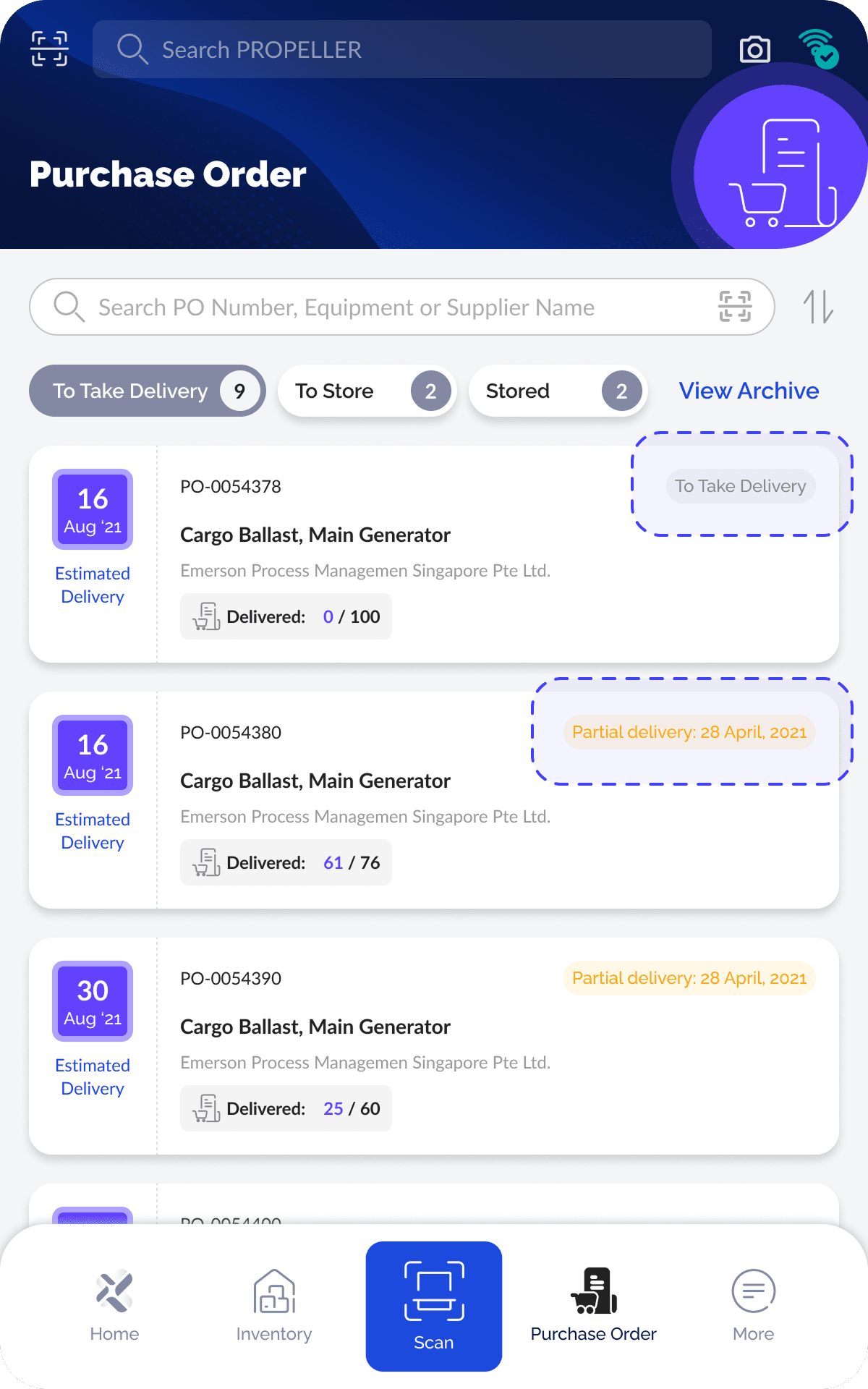
Engineers lacked clear visibility into the real-time status of purchase orders within the “To Take Delivery” section and often depended on the delivered quantity count at the bottom of the card to infer progress. This created unnecessary cognitive effort and slowed decision-making during delivery operations.
To address this, I introduced contextual status pills that surface the current state of each purchase order directly on the listing view. The new status indicators communicate whether an order is pending delivery or partially delivered, while partially delivered orders also display the latest delivery date for faster operational awareness and quicker decision-making.
Engineers lacked clear visibility into the real-time status of purchase orders within the “To Take Delivery” section and often depended on the delivered quantity count at the bottom of the card to infer progress. This created unnecessary cognitive effort and slowed decision-making during delivery operations.
To address this, I introduced contextual status pills that surface the current state of each purchase order directly on the listing view. The new status indicators communicate whether an order is pending delivery or partially delivered, while partially delivered orders also display the latest delivery date for faster operational awareness and quicker decision-making.

Before
Before

After
After
Delivered vs Ordered
Delivered vs Ordered
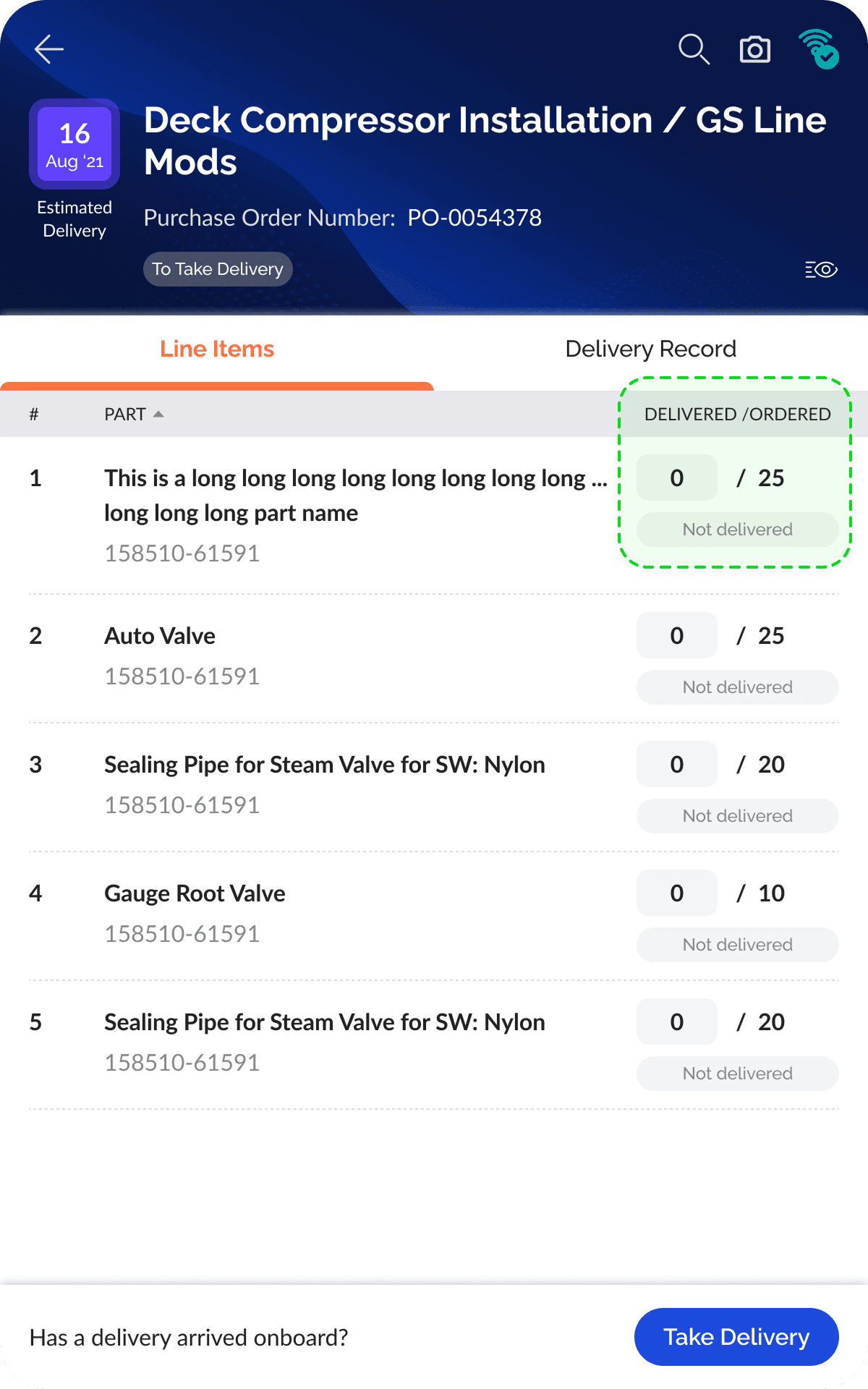
During partial deliveries, vessel engineers found it difficult to track the quantity of spares already delivered against the total quantity ordered. The previous experience did not provide clear visibility into earlier deliveries, forcing users to either refer to physical purchase order copies or navigate through older delivery records for clarification, which interrupted their current workflow.
To improve this experience, I introduced a Delivered vs Ordered indicator directly within the line items view. This gave engineers instant visibility into previously delivered quantities alongside the total ordered count, reducing confusion and eliminating the need to move back and forth between records
During partial deliveries, vessel engineers found it difficult to track the quantity of spares already delivered against the total quantity ordered. The previous experience did not provide clear visibility into earlier deliveries, forcing users to either refer to physical purchase order copies or navigate through older delivery records for clarification, which interrupted their current workflow.
To improve this experience, I introduced a Delivered vs Ordered indicator directly within the line items view. This gave engineers instant visibility into previously delivered quantities alongside the total ordered count, reducing confusion and eliminating the need to move back and forth between records
2.1. PO Details Page - Line Items Tab
2.1. PO Details Page - Line Items Tab

Before
Before
After
After
2.2. Take Delivery Page - Check Delivered Items
2.2. Take Delivery Page - Check Delivered Items
Before

After

Real-Time Delivery Verification Experience
Real-Time Delivery Verification Experience
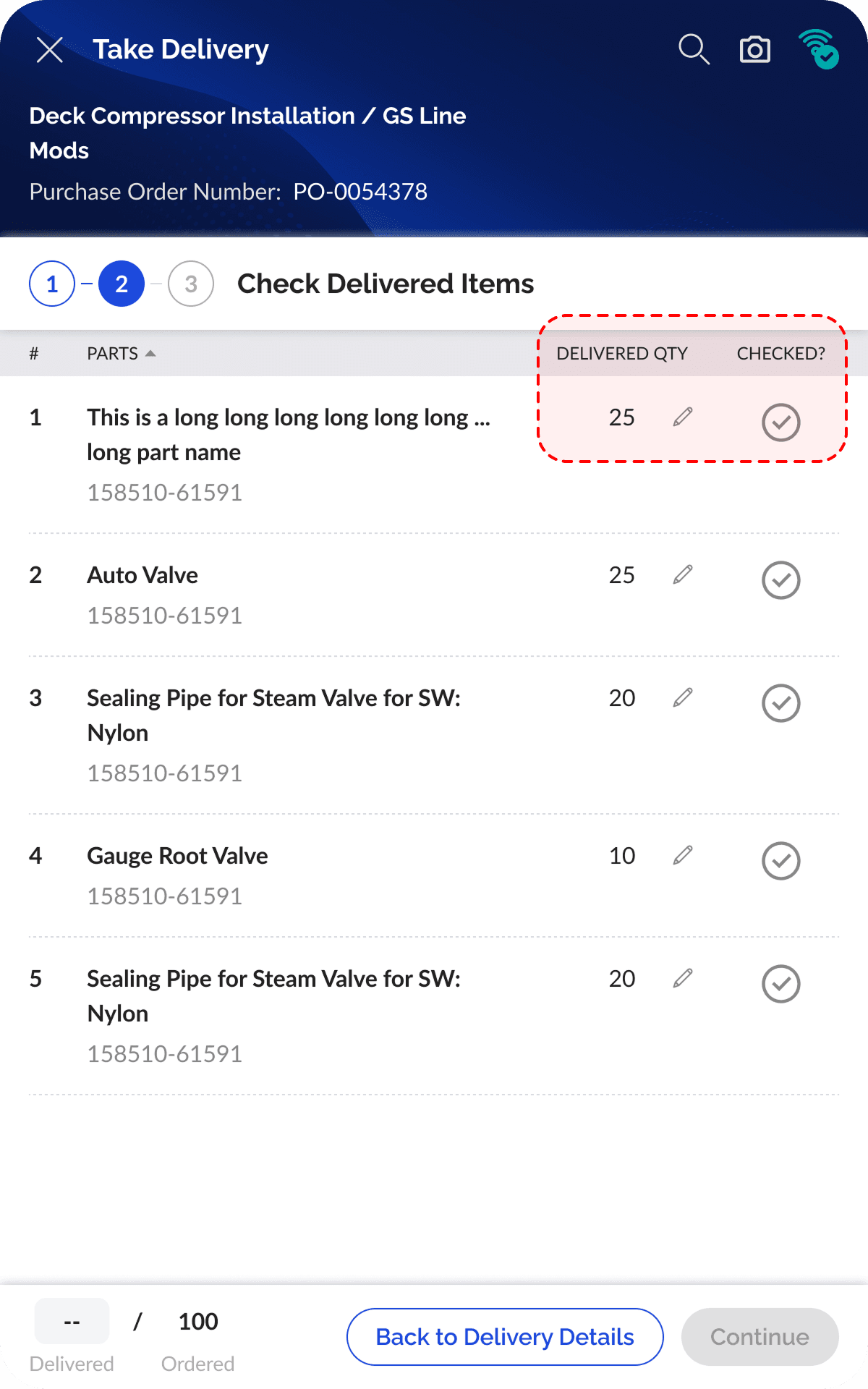
To make delivery verification faster and more intuitive, I redesigned the checking experience around real-time operational behaviour onboard vessels.
Line items are pre-selected by default, allowing engineers to quickly verify fully delivered items with minimal interaction. For partially delivered items, engineers can directly edit the delivered quantity inline, while undelivered items can simply be unchecked from the list.
I also introduced contextual guidance and real-time delivery statuses such as Fully Delivered, Partially Delivered, and Not Delivered to provide instant visibility into delivery progress during the workflow.
These changes reduced manual effort and helped engineers complete delivery verification more efficiently in high-pressure operational environments.
Improvements
Faster delivery verification
Reduced manual interactions
Simplified decision-making
Lower cognitive load during operations
Improved accuracy in partial delivery scenarios
To make delivery verification faster and more intuitive, I redesigned the checking experience around real-time operational behaviour onboard vessels.
Line items are pre-selected by default, allowing engineers to quickly verify fully delivered items with minimal interaction. For partially delivered items, engineers can directly edit the delivered quantity inline, while undelivered items can simply be unchecked from the list.
I also introduced contextual guidance and real-time delivery statuses such as Fully Delivered, Partially Delivered, and Not Delivered to provide instant visibility into delivery progress during the workflow.
These changes reduced manual effort and helped engineers complete delivery verification more efficiently in high-pressure operational environments.
Improvements
Faster delivery verification
Reduced manual interactions
Simplified decision-making
Lower cognitive load during operations
Improved accuracy in partial delivery scenarios

Before
Before
After
After
Impact & Outcomes
———
Impact & Outcomes
———
Impact & Outcomes
———
Following the redesign, the workflow better supported engineers in operational environments where speed and accuracy were critical.
Following the redesign, the workflow better supported engineers in operational environments where speed and accuracy were critical.
Estimated Outcomes
———-

Increased real-time workflow adoption
Increased real-time
workflow adoption
Reduced delayed data entry behaviour
Reduced delayed data
entry behaviour
Reduced data discrepancies across systems
Reduced data discrepancies
across systems
Reduced data
discrepancies
across systems
Improved delivery record accuracy
Improved delivery
record accuracy
Improved user confidence and task completion efficiency
Improved user confidence and task completion efficiency
Business Impact
———
Business Impact
———
The redesign helped bridge the gap between operational behavior and system expectations, improving both workflow reliability and data integrity.
The redesign helped bridge the gap between operational behavior and system expectations, improving both workflow reliability and data integrity.
Key Learnings
———
Key Learnings
———
Key Learnings
———
Designing for real-world behaviour matters more than designing for ideal flows
Designing for real-world behaviour matters more than designing for ideal flows
Users will always optimize for speed and reliability in high-pressure environments.
Users will always optimize for speed and reliability in high-pressure environments.
Mental models strongly influence adoption
Mental models strongly influence adoption
Even small workflow changes can create major operational friction if they conflict with existing habits.
Even small workflow changes can create major operational friction if they conflict with existing habits.
Simplicity builds confidence
Simplicity builds confidence
Reducing ambiguity was more impactful than adding additional functionality.
Reducing ambiguity was more impactful than adding additional functionality.
Product success depends on operational alignment
Product success depends on operational alignment
A technically correct workflow can still fail if it does not fit naturally into users’ day-to-day realities.
A technically correct workflow can still fail if it does not fit naturally into users’ day-to-day realities.
Next Steps
———
Next Steps
———
Next Steps
———
If given additional time, I would further explore:
Offline support for unstable maritime network conditions
Voice-assisted logging for hands-free operations
Predictive delivery suggestions based on previous workflows
Integration with inventory and maintenance systems
Operational analytics dashboards for management teams
If given additional time, I would further explore:
Offline support for unstable maritime network conditions
Voice-assisted logging for hands-free operations
Predictive delivery suggestions based on previous workflows
Integration with inventory and maintenance systems
Operational analytics dashboards for management teams
Reflection
———
Reflection
———
Reflection
———
This project reinforced the importance of designing beyond screens.
The challenge was not simply improving usability — it was understanding human behavior in operational environments where time, pressure, and familiarity directly influence decision-making.
By aligning the workflow with real-world vessel operations, the redesign improved adoption, reduced ambiguity, and created a more reliable operational experience for engineers onboard.
This project reinforced the importance of designing beyond screens.
The challenge was not simply improving usability — it was understanding human behavior in operational environments where time, pressure, and familiarity directly influence decision-making.
By aligning the workflow with real-world vessel operations, the redesign improved adoption, reduced ambiguity, and created a more reliable operational experience for engineers onboard.

Thanks for exploring this case study.
Ready for the next project?
———
Thanks for exploring this
case study.
Ready for the next project?
———
Back to Top
Next Project